It is easy to be confused about the difference between being present and self-absorbed. Current New Age, pop psychology, and self-help literature often make them seem the same. This is far from the truth. In my experience, both personal and professional, being present and being self-absorbed differ in several ways. The two that feel most significant are: 1) being present creates a spirit and mindset of service to others, and 2) when we are present, we are aware of our inner experiences on many levels AND what is happening around us. When we are self-absorbed, the rest of the world takes a backseat to our own experiences and our own needs/wants/preferences.

The Difference Between Being Present and Self-Absorbed: Me
I have had the opportunity to spend time lately with somebody who is very committed to their spiritual practices of bowing, chanting, and meditation. They spend much more time doing all of them than I do. There is an intensity and tenacity to their commitment that is palpable. This inspires me. When you hear this person speak, you will hear them talk constantly about “being present” every minute of every day. What I find fascinating, from observation and experience with my friend, is that they are rarely aware of what happens around them. When you walk into a room, they are always startled when they see you standing there. If you are in the same room and speaking with somebody else, they have no idea what the conversation is about, even if they’re sitting at the same table, because they don’t listen and aren’t involved. When they are working on a project, they get so deeply immersed that they don’t notice when others need the space they are working in or the tools they are using. In short, they are so “present” that they have no idea what happens around them except when it involves them directly. This is the difference between being present and self-absorbed. Self-absorbed people often don’t connect with others or their environment unless they need or want something from the situation. Meaning, it is about them.
The Difference Between Being Present and Self-Absorbed: We
At the same time, I have another person in my life who is a shining example of being present. This person is very focused on whatever activity they are engaged in and the world around them. They are tuned in to their own inner experiences AND all of us as well. They are present whether they are trying to meet their own needs and wants or not. They put 100% attention into whatever they are doing and are still connected to us; there is no separation between their needs and our needs. Being present means being our best self so we can be of service. I invite you not to get seduced by the new age, pop psychology, and self-help literature that will try to convince you that the goal of being present is to have a better life. The premise is based on my needs and wants as the purpose for being present. This is false and rarely benefits anyone, including us. My friend, who is present, often moves easily from whatever they are doing to what needs to be accomplished for the whole, knowing that we are greater than me. That does not mean that they do not take care of themselves; they do. They are present enough to know that the greater we are, the more important we are than me and my personal needs and wants. Those who are present experience that there is little difference between me and we; I am part of the whole and the whole is part of me. The separation we create in our minds often comes from our ego. The Higher Self does not make this distinction.

The Difference Between Being Present and Self-Absorbed: Teachers
I encourage you to find models and teachers who support the practice of being present as preparation for service, not self-centeredness dressed as “mindfulness”. In my personal experience, when I reflect on my first handful of years of meditation, it’s clear that what I identified as being present was just another form of self-absorption. The goal of meditation was to feel better. It was all about me and my needs and wants. Service was typically another way for me to feel better about myself and to get recognition and attention for doing something “good”. If you have ever had the opportunity to experience interacting with monks and nuns who live in monasteries, you can clearly feel the difference between being present and self-absorbed. Don’t be fooled by those who earn a very substantial living off you buying their books and resources in the name of teaching others about being present and the present moment. Folks like the Dalai Lama, Thich Nhat Hanh, Pema Chodron, Mikao Usui Sensei, and Thomas Merton, among others, didn’t focus much on branding and marketing their work. They knew it wasn’t for them; they were sharing their wisdom, so they probably didn’t benefit much from it personally. They already received their “rewards” before they even wrote the book!

“It is important sometimes to reflect on our thoughts and feelings, monitor them, and make sure they are taking us where we want to go. However, a constant state of monitoring will lead us to be too self-conscious. If we are always worried about “What am I thinking?” or “What am I feeling?” then we can never engage in our surroundings with full consciousness. This is when self-awareness becomes more than just self-awareness, it becomes self-absorption, and this can end up being very detrimental.
Self-absorption is when we are too preoccupied with our inner world to appreciate our outer world. It is when we find ourselves chatting away in our heads and making petty judgments, instead of letting go and living presently with what surrounds us.
Imagine what a self-absorbed person would be like to hang out with. You try to have a conversation with them or play a game, but they are never fully “there.” Their attention is constantly shifting from one thought to the next. They are always reflecting, so they seem disinterested in everything else going on around them.
We’ve all been in a similar situation before. Instead of seizing the moment for what it is we get stuck in our heads with questions like, “Why am I here?” or “What am I doing?” We over-think, over-analyze, and simultaneously disconnect ourselves from the world.” Excerpt from Self-Absorbed vs Self-Centered by
The Difference Between Being Present & Self-Absorbed: The Higher Self
An easy way to tell who is writing about being present, the present moment, and mindfulness is to see who earns the money from book sales. If the revenue primarily goes to the author, I invite you to reconsider letting them be a spiritual guide or teacher on your journey. If most of the proceeds go to an organization instead of the writer, that may be someone who can guide you in the right direction toward an authentic experience. Of course, we always need to use our own inner discernment in all situations, especially with spiritual teachers and mentors. This is critical! Please do not take my word for it. It is your journey; therefore, it is your responsibility to access your own inner discernment through the Higher Self. Our egos, intellect, fears, and ambitions are not working in our best interest. Again, it is critical that we do our own inner discernment through the Higher Self. Nobody can do this for us.
Tao Te Ching – Lao Tzu – Chapter 49
The sage has no mind of his own.
He is aware of the needs of others.
I am good to people who are good.
I am also good to people who are not good.
Because Virtue is goodness.
I have faith in people who are faithful.
I also have faith in people who are not faithful.
Because Virtue is faithfulness.
The sage is shy and humble – to the world he seems confusing.
Men look to him and listen.
He behaves like a little child.
(translation by Gia-fu Feng and Jane English)

Have you ever been around someone who is self-absorbed but thinks they are present? What is your own experience with the difference between being present and self-absorbed?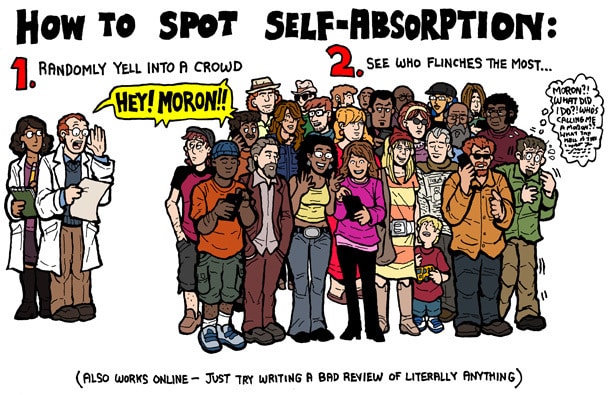
Other posts you may enjoy:
Spiritual Change: Tie Your Shoes Different
Spiritual Training on Humility: The Janitor Part I
Life Lessons Learned from Akeelah and The Bee
10 Signs You’ve Found Your Calling | Wake Up World
Michael Swerdloff
Providence Holistic Counselor, Coach and Reiki